Article: The Hands Behind Flair: Honouring Our Artisans

The Hands Behind Flair: Honouring Our Artisans
At Flair, every piece begins with a human gesture - a hand shaping clay, cutting tile, knotting wool, or forming molten glass. Our collections are not created on assembly lines or through automated systems. They are shaped in workshops, villages, and family studios across Morocco, where craftsmanship is not only a profession but a living inheritance.
We work closely with artisans whose techniques have been refined over generations. Their knowledge is not written in manuals or stored in software, but carried through repetition, observation, and experience. Each object reflects time, process, and presence. This is what gives handcrafted work its depth - and why no two pieces are ever exactly alike.
Here is a closer look at the makers and traditions behind some of the pieces you discover at Flair.
Tamegroute Ceramics - Shaping Clay at the Edge of the Desert
In the village of Tamegroute, near Zagora at the edge of the desert, ceramicist Rachid has practiced traditional pottery for over twenty-eight years. He belongs to one of only eleven families who continue a ceramic tradition dating back more than four centuries. This oasis village was once one of the final stops before the Sahara caravan routes, and its ceramic identity remains deeply tied to that history.
The work begins with clay extracted from underground deposits that can reach depths of up to ten meters. Preparing this material is physically demanding and requires careful selection and conditioning. It is then shaped by hand using an underground potter’s wheel - a distinctive local method that calls for strength, control, and familiarity with the material.
Rachid does not rely on measurement tools. Balance and proportion are judged by eye alone. As expressed in a traditional Arabic saying shared among artisans - “my eyes are my measure.” Years of practice allow him to refine each curve instinctively, guided by experience rather than calculation.
Once formed, the pieces are left to dry naturally before being fired in dome-shaped kilns for around eight hours at temperatures approaching 1100°C. Variations in flame, minerals, and heat create subtle differences in glaze tone and surface texture. These nuances are intrinsic to Tamegroute ceramics — each piece carries its own visual signature.
Zellige of Fez - Geometry Cut by Hand
In the historic city of Fez, Hamza practices the demanding art of zellige - hand-cut mosaic tilework that has shaped Moroccan architecture for centuries. This discipline requires long training and exceptional precision, preserved through workshop apprenticeship and hands-on learning.
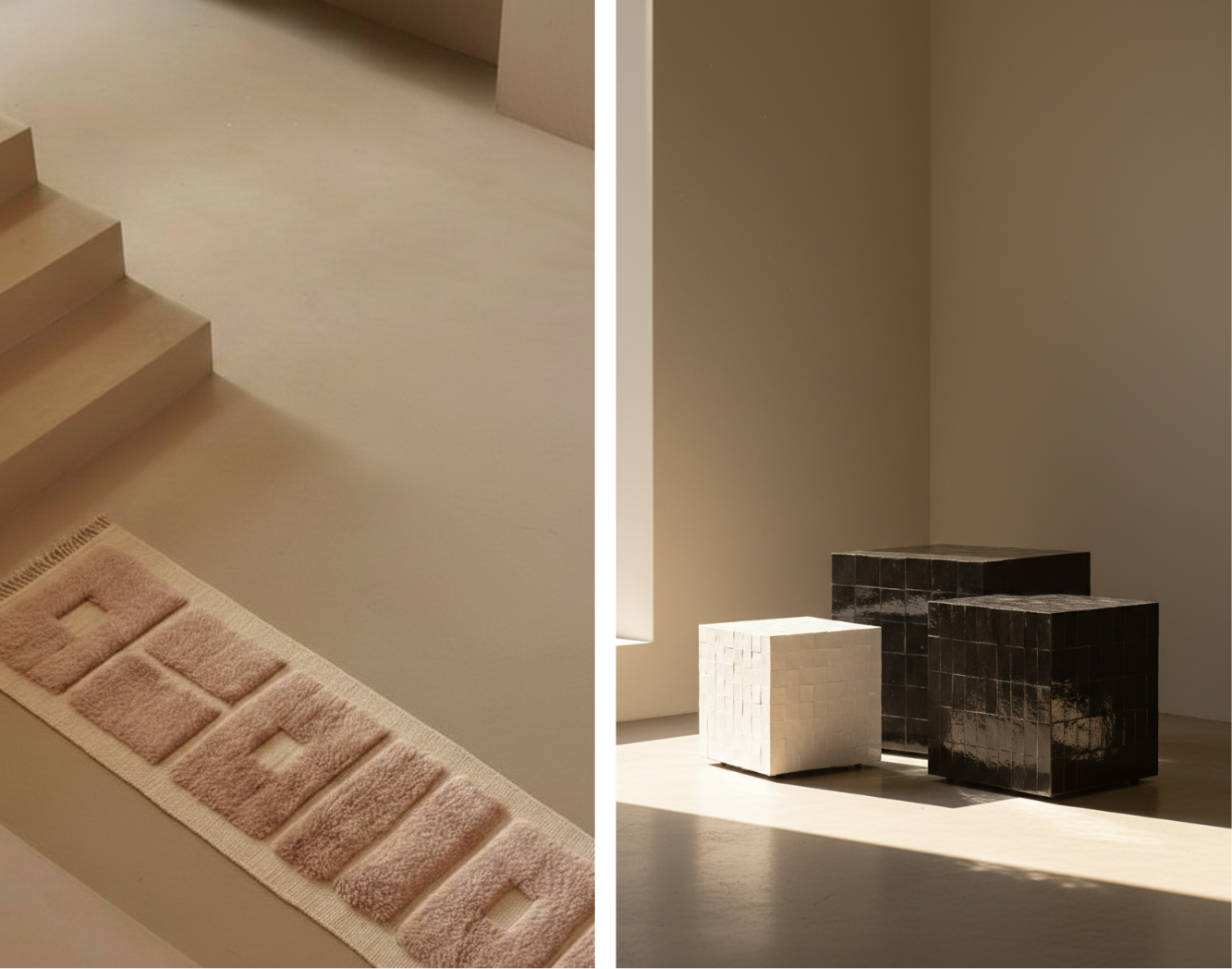
The process starts with natural clay sourced from the Fez region, valued for its density and workability. After soaking and kneading, the clay is pressed into tiles using wooden molds. These are dried and fired to create a solid ceramic base.
Each tile is then glazed by hand using mineral pigments and returned to the kiln for a second firing. After cooling, the most intricate stage begins: cutting. Using a small hammer and chisel, Hamza shapes each tile into precise geometric fragments. There are no automated cutters or digital guides - accuracy depends entirely on hand control and visual judgment.
The fragments are assembled face down into complex patterns rooted in mathematical balance and Islamic geometric principles. Because every cut is made manually, slight variations appear in line and alignment. Rather than diminishing the work, these details give zellige surfaces their vitality - a living geometry shaped by the human hand.
Handwoven in the Middle Atlas - Rugs of Time and Gesture
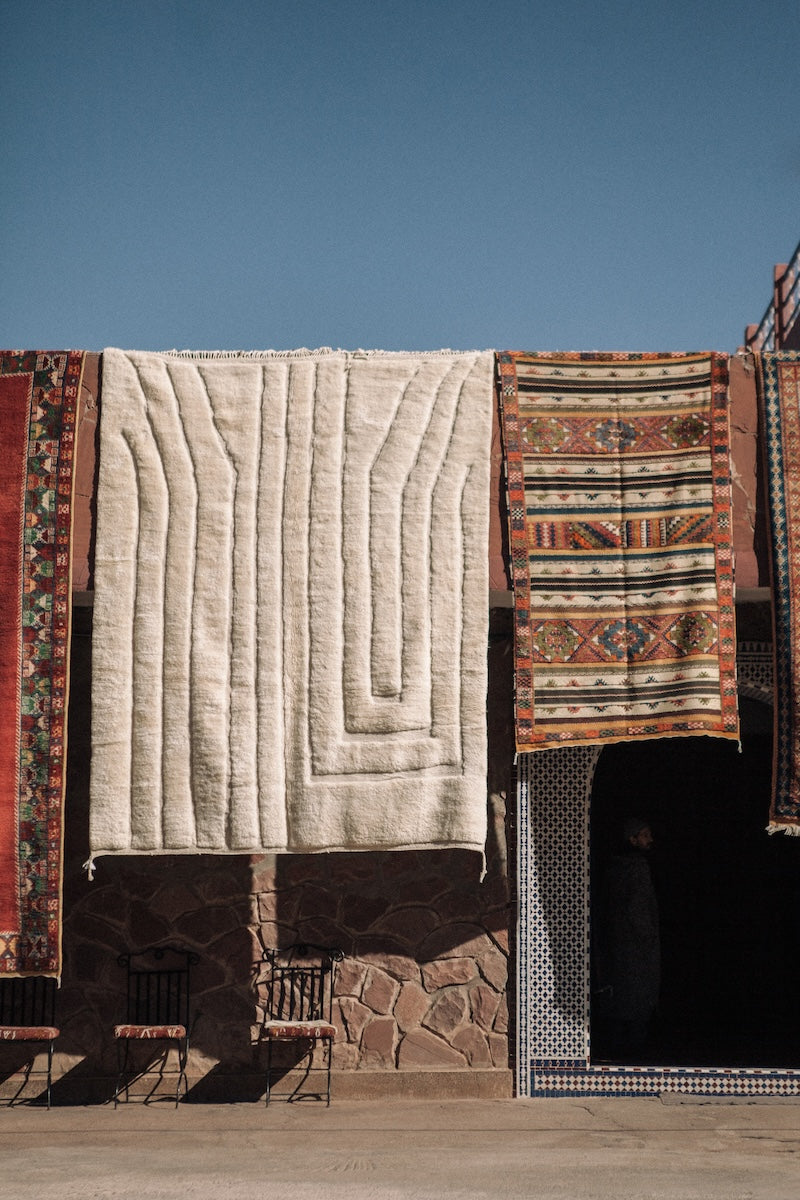
In the Middle Atlas region around Khenifra, rug weaving is traditionally practiced by women and passed from generation to generation. Amina, one of the weavers we collaborate with, learned through observation and daily practice within her family - as many before her have done.
She works on a traditional loom, weaving wool entirely by hand. The process is slow and rhythmic: spinning, knotting, tightening, and trimming, row by row. Designs are rarely drawn in advance. Instead, they are remembered and interpreted - guided by instinct and inherited visual language.
Weaving takes place alongside daily life. The loom is often positioned near the home, allowing the work to progress gradually throughout the day. This rhythm gives each rug a sense of warmth and authenticity. It is not produced in isolation, but within a lived environment.
When the rug is complete, it is washed repeatedly in the river valley, brushed by hand, and dried naturally under the sun. Water, movement, and air soften the wool and reveal tonal variation. Differences in density, pattern spacing, and texture reflect the human pace of the work and contribute to the individuality of each piece.
Beldi Glass of Marrakech - Recycled Glass Shaped by Breath
In Marrakech, Mohamed is among the artisans preserving the tradition of mouth-blown beldi glass - a Moroccan glassmaking practice dating back to the 1940s and now maintained by only a small number of workshops.
Beldi glass is produced entirely from recycled materials. Clear pieces typically come from recycled soft-drink bottles, while green and amber tones are created from beer bottles. The glass is melted in furnaces heated to approximately 1600°C, kept running continuously day and night.
When molten, the glass is gathered on a blowpipe and shaped through breath and rotation. Form depends on airflow, timing, and hand movement. The process demands coordination and experience - too hot and the glass collapses, too cool and it resists shaping.
Edges are trimmed using a flame tool, and any excess material is returned to the furnace for reuse. Nothing is discarded. Finished pieces cool slowly in annealing ovens to strengthen the structure and prevent stress.
Because each object is shaped through breath and gesture, slight differences in thickness and silhouette naturally occur. These variations are the mark of handmade glass - subtle evidence of the artisan’s presence.
Craft as Living Knowledge - From Workshop to Contemporary Home
Across ceramics, zellige, weaving, and glassmaking, what unites these disciplines is continuity. These crafts endure because they are practiced, taught, and valued. Knowledge moves forward through doing - not theory - carried by skilled hands over time.
At Flair, we curate these works for contemporary living while preserving the integrity of their origin and process. We adapt where necessary, but never at the expense of authenticity. Variation is not corrected - it is respected. Individuality is not hidden - it is celebrated.
Behind every piece is more than material and function. There is time, memory, and human intelligence - shaped by hand, and made to last.